
The Conservation Sector’s
Dirty Little Secret
Seventy-nine percent of charities now use AI routinely. Only eighteen percent have a policy governing it.
So can a nature organisation use AI in good conscience?
We have adopted AI without governing it
Seventy-nine percent of charities now use AI routinely. Only eighteen percent have a policy governing it. Half have nothing written down at all, and only seven percent review AI risk at board level.
For a sector whose authority rests entirely on evidence, care and the precautionary principle, that gap should be uncomfortable. We have adopted a technology whose environmental costs we have not measured, under governance we have not written, while the people who build it warn publicly that they may not be able to control it.
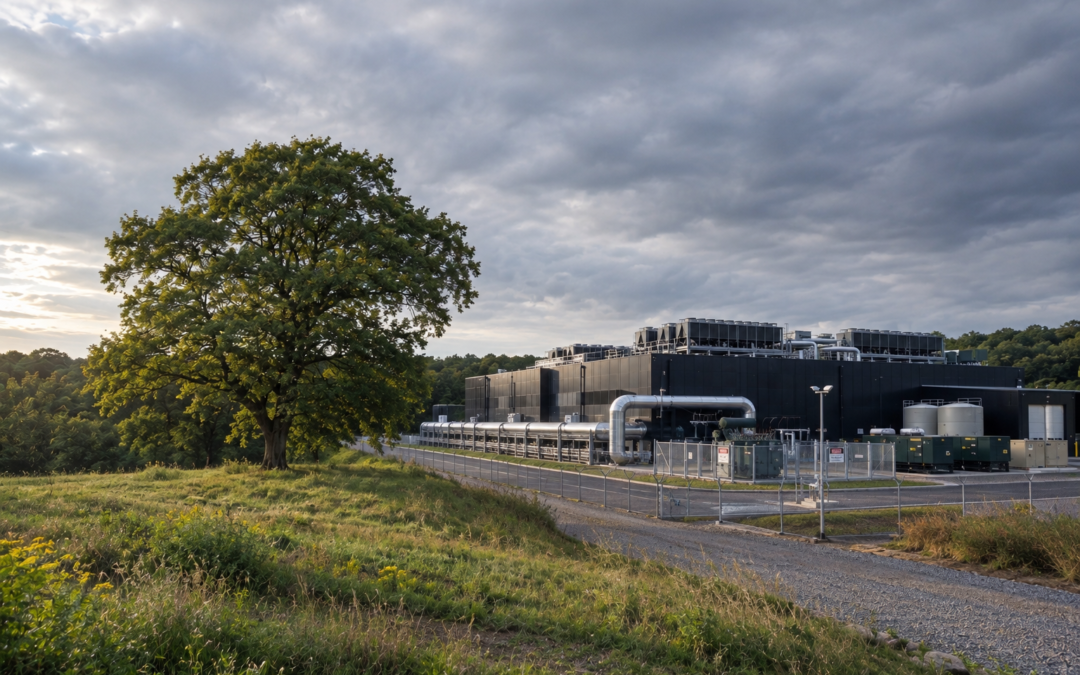
AI is transforming what conservation can measure, monitor and predict. It is also driving one of the largest infrastructure buildouts of our lifetime, with real consequences for land, water, air and the life that depends on them. Most of our sector has no settled position on either.
AI is taking a toll on the planet
The warnings are no longer coming from critics. They come from the builders. Dario Amodei, who runs one of the three leading AI labs, puts the odds of things going “really, really badly” at 25 percent. Seventy-four thousand people have signed a statement calling for a prohibition on superintelligence. None of that discourse mentions the biosphere, and while it has been running, the material footprint has arrived.
This often gets discussed as an issue of carbon emissions, but that misses a large part of the picture. The damage shows up in land, water and air, and in the life that depends on them.
| Impact | Where it stands |
|---|---|
| Electricity | Data centres used 485 TWh in 2025. The IEA expects roughly 950 TWh by 2030, close to 3 percent of world electricity, with AI-specific demand tripling over the same period. |
| Grid pressure | Data centres took 23 percent of Ireland’s national electricity in 2025, a 360 percent rise in a decade. US coal generation rose 13 percent in 2025, in significant part to serve these facilities. |
| Land | Projected land take reaches 14,500 km² by 2030, roughly twice the area of greater Jakarta, once the generating estate behind it is counted. |
| Water | Google’s water consumption rose 34 percent in 2025, to 10.9 billion gallons. Corporate “water positive” pledges count on-site cooling only, and the water evaporated generating the electricity can be three to ten times larger. |
| Materials | Cumulative e-waste from generative AI is projected at 1.2 to 5 million tonnes across 2020 to 2030, with copper demand for grid infrastructure the largest single mineral pressure. |
More persuasive than any of that is what happens at a local level.
In Uruguay, Google was permitted to draw fresh water to cool a data centre during the worst drought in seventy years, while residents of Montevideo were served brackish water pumped from the Río de la Plata. In Memphis, xAI is running 33 gas turbines without permits beside its data centre, in counties the American Lung Association already grades F for ozone. The NAACP is suing.
In both places, the people paying the cost are not the people the technology serves.
The industry’s climate case is thinner than its marketing. Of more than 150 climate-benefit claims made by AI companies, 36 percent had no supporting evidence at all. Google’s much-repeated claim that AI could cut 5 to 10 percent of global emissions traces back to an anecdote in a 2021 consulting blog post.
Resistance is building. In the first quarter of 2026 alone, communities across 49 states blocked or delayed more than 75 projects worth around $130 billion. Regulators are moving too, with more than 300 data centre bills filed across 30 US states in the first six weeks of the year, a statewide moratorium in New York, and a UK judicial review that forced the government to accept that environmental conditions attached to a data centre consent must be legally binding. Whether any of it amounts to effective regulation is contested, and the honest answer is that nobody yet knows.
What matters for us is simpler. This has become a fight about land, water and air, conducted through planning and permitting, and it is happening almost entirely without conservation expertise in the room. At the first UN dialogue on AI governance, held in Geneva in July, Brian O’Donnell of the Campaign for Nature made exactly this point: nature is not being discussed at all.
And yet the capability is real
Here is the part that makes a blanket refusal difficult. This technology is doing things for nature that nothing else can do at the same cost.
Camera trap classifiers identify thousands of species at near-expert accuracy on an ordinary laptop. Bioacoustic models put species-level identification in anyone’s pocket. Satellite foundation models now map the entire land surface at ten metre resolution, free to use. For a two-person field team, some of this is the difference between analysing a season’s data and never getting to it.
What matters more than what these tools can see is what they can change, and there the evidence is thinner but far more interesting. After Indigenous community groups in Peru were given real-time deforestation alerts from Global Forest Watch, deforestation fell 52 percent.
That single result illustrates the whole case for AI, at the scale of one landscape. The technology did not achieve it on its own. It worked because the communities receiving the alerts already held rights over the land, had the authority to act, and had the means to act quickly. Give the same alerts to people without those things and nothing changes.
We are not short of models. We are short of the conditions in which a model changes anything.
That pattern holds across the literature. WILDLABS has five years of survey data from 1,073 practitioners in 101 countries, and its finding is damning in a useful way: AI tools are rated among the highest-potential technologies in conservation and the lowest in practical implementation. Perceived value is not readiness. The barriers practitioners name are not algorithmic. They are data maintenance, training, and the near-total absence of people who can translate between the two worlds.
But most use is not conservation AI at all
Most of the AI use that actually happens in our organisations is unglamorous: drafting, summarising, desk research, funding applications. Service delivery barely registers. When 79 percent of charities say they use AI, they mostly mean email.
Any serious conservation organisation needs to think carefully about both the models it wants to build and use to deliver conservation outcomes, and the tools its staff are using every day. Those two things need different instruments.
The question is not whether. It is when.
So we have a technology with serious and worsening environmental costs, a genuine and demonstrated capability, and near-universal adoption already happening inside organisations that have no policy on it. The ethical dilemma is real. The instinct for some in our sector is to resolve it by abstaining.
Plenty of people now argue against abstention. Nonprofit Quarterly, Candid and the Chronicle of Philanthropy have all published a version of that case in the last eighteen months. Many of the organisations we work with remain sceptical of it, and the scepticism is reasonable. The case is usually made for nonprofits in general, and it rarely engages with what abstention means for a sector whose entire purpose is the thing AI is damaging.
Our view is that AI is too powerful a tool for this sector to ignore, and that abstaining carries its own risk of being left behind. The harm AI does to nature is almost entirely a function of where data centres get built, what powers them, and who bears the local cost. An individual organisation declining to use AI changes none of those things. It forgoes the capability and leaves the harm precisely where it was. That is a purity position, not an effectiveness one. And when 79 percent of organisations use AI and half have no policy, a ban does not deliver purity either. It produces use that nobody is governing.
So AI should be used deliberately, against a test the organisation has actually written down. And organisations should use the skills they already have to influence how this infrastructure gets regulated and built. Here is a test that works.
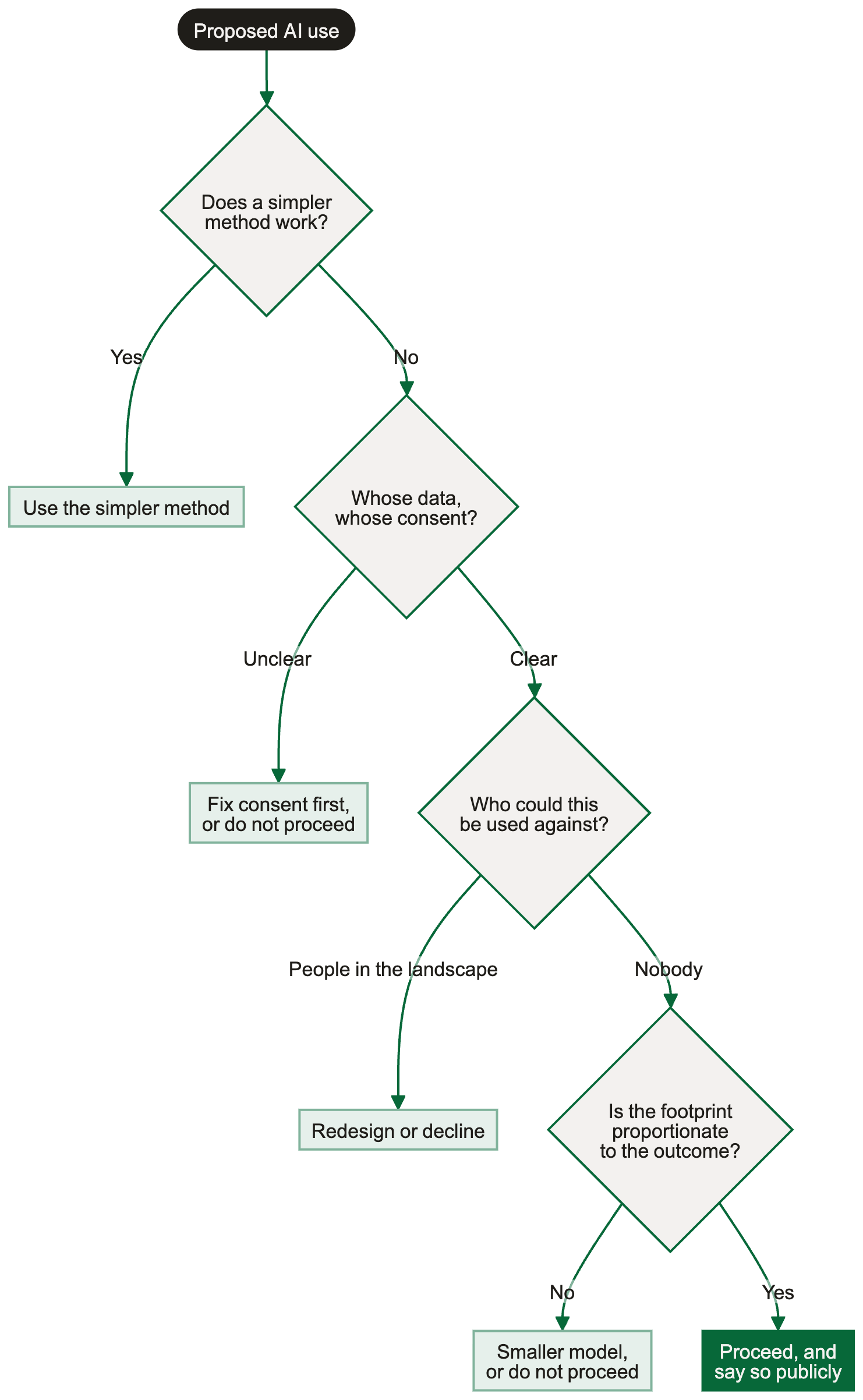
The order matters, and the footprint question comes last on purpose, because it is the one most often used to avoid the harder three.
That test is for deployments. The everyday layer needs something lighter, and it starts with settling the footprint question honestly.
Asking a chatbot ten questions a day comes to roughly 0.03 percent of a person’s daily electricity use. Your correspondence is not the problem, and anyone telling you otherwise is misdirecting you. That is not absolution either, because the aggregate demand and the infrastructure built to serve it are exactly the problem described above. They are two different questions and they need to stay separate.
One habit is worth changing. Per thousand uses, generating text costs around 0.05 kWh. Generating images costs nearly three. That difference falls on the one use our sector should already be wary of. When Bond examined AI-generated imagery from seventeen NGOs this year, 85 percent was properly labelled and it made little difference. Audiences argued about authenticity rather than the cause, and one WWF campaign was criticised for using energy-intensive AI to talk about sustainability. Disclosure is necessary, but it does not buy the trust back.
So there is a small energy question attached to everyday use, but it is not the one that should worry you most. The real risks are confidentiality and consent, when community information goes into a tool nobody approved, and credibility, when AI-assisted work goes out under our name. The Information Commissioner’s Office has already written a good version of the standard for its own staff. Approved tools only. No personal, community or confidential information unless the tool is cleared for it. A named person accountable for anything that leaves the organisation, with substantially AI-generated content labelled as such. Drafting and summarising need no disclosure. Published imagery is where you stop and think.
What the test really does is force the question down to the level of a specific use, which is where it belongs. A fine-tuned vision model running on a laptop and a frontier model drafting a funding bid differ by orders of magnitude in footprint, in what they do with other people’s data, and in who they could be turned against. Treating them as one thing called “AI”, and then approving or banning that one thing, is the mistake almost everyone is currently making.
None of this is unfamiliar territory for us. It is proportionality, consent and impact, applied to a new kind of proposal.
Three things to do about it
1. Write the policy, and make it about uses rather than tools
Most of the sector has nothing. A policy that says “no AI note-takers” is defensible as far as it goes, because confidentiality and consent in community consultation are real concerns, but it answers at the level of the technology rather than the use, and it leaves the camera trap classifier and the funding bid and the satellite model entirely ungoverned. The policy that works names the uses, sets the consent standard for anything involving communities, and puts a threshold on what gets escalated. A ban does not stop the use either. In a survey of 917 US nonprofits published this month, 53 percent reported informal AI use outside any organisational guidance, and executives did it at a higher rate than their staff.
The IUCN adopted a motion on AI governance at Abu Dhabi last October. It is worth reading, but note what it actually does: it mandates a working group to develop a Union-wide policy. That policy does not yet exist. Nobody is coming to write yours.
2. Measure what you use, and publish it
The single most credible thing a conservation organisation can do here is model the transparency it demands from everyone else. If you cannot state roughly what your AI use costs, you are in the same position as the companies whose disclosures you would not accept. The UN Secretary-General launched an AI Environmental Transparency Initiative in June, asking AI companies to disclose the full environmental cost of their systems. A sector demanding that disclosure should be able to produce its own.
3. Turn your actual expertise on the actual problem
This is the part the sector is missing entirely. The data centre buildout is a land use, water allocation and permitting fight, happening right now, in exactly the jurisdictions where conservation organisations already have standing, relationships and technical credibility. More than 75 projects were blocked or delayed in a single quarter, mostly by residents arguing about electricity bills and noise. Almost none of that opposition has ecological expertise attached to it.
The Nature Conservancy is front and centre on this. Its position on responsible AI use and infrastructure development commits TNC to assessing both its AI deployments and AI infrastructure itself on the same avoid, minimise, mitigate and restore hierarchy it applies to any other development, and to working on the policies and infrastructure choices that determine where these facilities go. That was published in April 2026. A handful have moved since. The National Wildlife Federation’s 52 affiliates passed a data centre resolution in June, and the Australian Conservation Foundation has set out what it wants attached to approvals in Australia. Almost all of it is opposition rather than conditions.
Follow it, and then go further than opposition. Elena Doms at Oxygen Conservation recently put the better question: what if the next data centre approval came with a restoration condition attached? That is the move. Not stopping the buildout, which will not happen, but shaping it, the way this sector already shapes every other major infrastructure programme. Siting away from sensitive habitat and irreplaceable ecosystems. Closed-loop cooling as a permit condition in water-stressed catchments. Biodiversity net gain on the land take and the transmission corridors. Grid connections that do not quietly extend the life of a coal plant. These are conditions our sector knows how to write, and almost nobody is currently at the table writing them.
An organisation that uses AI carefully, measures it honestly, and brings its planning and habitat expertise to bear on where these facilities go has far more effect on AI’s footprint than one that quietly abstains and says nothing.
Our sector must lead by example
The conservation sector is good at exactly this kind of problem. We spend our working lives on questions where the benefit is real, the harm is real, the evidence is incomplete and the answer is neither yes nor no but a well-reasoned set of conditions. That is what an impact assessment is. That is what a mitigation hierarchy is.
We have simply not yet applied that discipline to ourselves.
The dirty little secret is not that conservation organisations use AI. It is that we use it the way we would never tolerate a developer using a floodplain: without assessment, without conditions, and without saying so out loud.
We can help
Global Conservation Solutions works with conservation organisations, agencies and funders on exactly this question. That means a usable AI policy written around uses rather than tools, and governed at board level. An honest assessment of where AI earns its place in your work and where a simpler method does the job better. A clear view of the data you already hold and what could realistically be done with it. And support to bring your own planning, water and habitat expertise to the infrastructure decisions now being made around you.
If your organisation has not had this conversation yet, it is overdue. Get in touch and we will help you have it.
A note on how this was made
AI was used to research and draft this article. Every figure in it is traced to a named source below, and Dr. Scott Culligan is accountable for the argument and for anything that turns out to be wrong. That is the standard we have just asked of everyone else, so it would be strange not to meet it here.
Adoption and policy figures: Charity Digital Skills Report 2026. Energy: IEA, Key Questions on Energy and AI, April 2026, and Irish CSO via RTÉ, July 2026. Land and water: UNU-INWEH, June 2026, and SourceMaterial and The Guardian, April 2025. Memphis: Earthjustice and the NAACP, May 2026. Project opposition: Data Center Watch Q1 2026. Climate claims: Beyond Fossil Fuels and the Green Web Foundation, February 2026. Nature and AI governance: Climate Home News on the first UN dialogue on AI governance, July 2026. Conservation applications and the Peru result: WRI, AI for Nature, November 2025. Satellite foundation models: Google DeepMind, AlphaEarth Foundations, July 2025. Practitioner data: WILDLABS State of Conservation Technology, June 2026. Everyday use and its footprint: Hannah Ritchie on the footprint of a chatbot query, August 2025, and Luccioni, Jernite and Strubell, Power Hungry Processing. AI imagery and audience trust: Bond on University of East Anglia research, March 2026. Shadow use: NTEN and Bridgespan, State of Nonprofit AI Adoption and Governance, September 2026. Staff use standard: ICO internal AI use policy, August 2025. Transparency: UN Secretary-General’s AI Environmental Transparency Initiative, June 2026. Governance: IUCN Motion 143 and The Nature Conservancy on responsible AI and infrastructure; National Wildlife Federation annual meeting resolutions, June 2026; Australian Conservation Foundation on AI data centres, July 2026.